
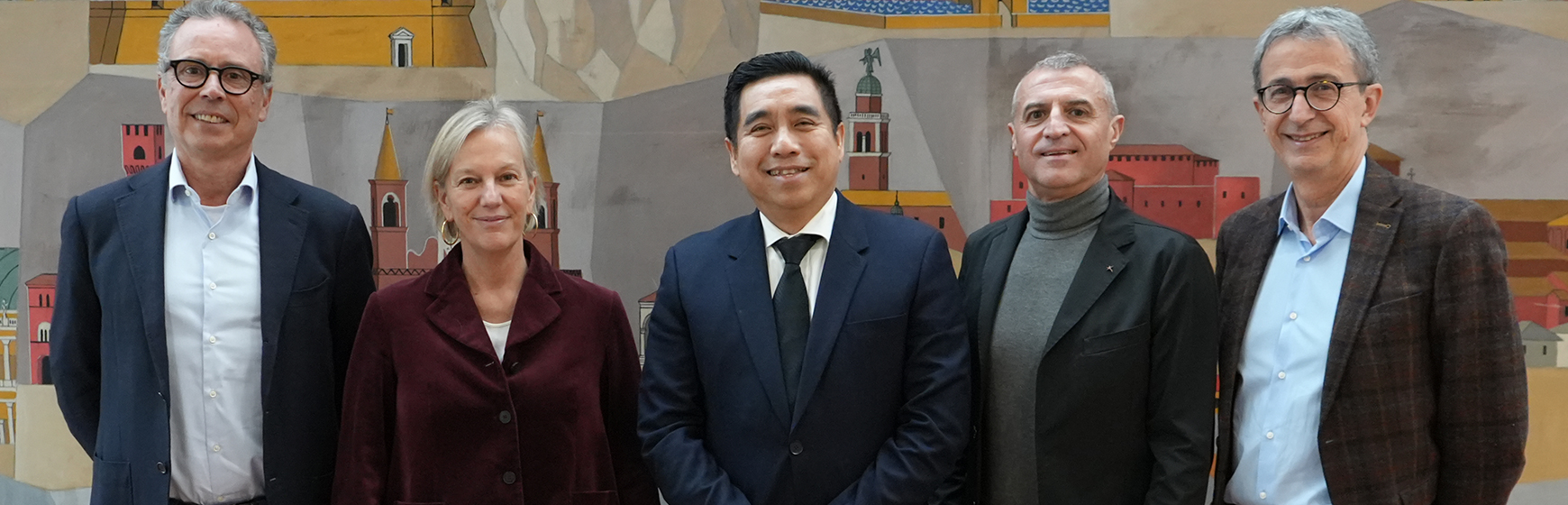
Italian excellence in veterinary health serving global public health: the Istituto Zooprofilattico Sperimentale delle Venezie (IZSVe) and the Istituto Zooprofilattico Sperimentale della Lombardia ed Emilia-Romagna (IZSLER) have been officially designated as FAO Reference Centres for reducing antimicrobials in farms to promote sustainable transformation of agrifood systems (RENOFARM – Reduce the Need for Antimicrobials on Farms for Sustainable Agrifood Systems Transformation).
This is the world’s first Reference Centre tasked with providing technical and scientific support to FAO on this crucial issue for the planet’s future. Achieved with the support of the Italian Ministry of Health, this milestone places Italy at the forefront of sustainable transformation in agrifood systems thanks to the excellence of the two Institutes.
Scientific leadership: statements made by the Health Directors
The operational leadership of the centre has been entrusted to the Health Directors of the two Institutes, Drs. Giovanni Cattoli (IZSVe) and Giovanni Alborali (IZSLER), who emphasized the international significance of the assignment.
 Dr. Giovanni Cattoli, Health Director of IZSVe, expressed his satisfaction:
“I am very proud of this designation. It acknowledges the commitment and professional expertise of our Institutes in a sector that is both critical and essential to public health. Antimicrobial resistance remains a major threat to public health worldwide. In recent years, most European countries, including Italy, have managed to reduce the use of antimicrobials in livestock production, while human consumption has remained almost unchanged.
Together with our colleagues at IZSLER, we plan to continue working in this direction, supported by the strong collaboration we have developed with FAO—specifically with the Animal Production and Health Division—in initiatives designed to reduce the need for antimicrobial use. Global data show that the impact of antimicrobial resistance remains high in countries with limited economic resources, where the use of antimicrobials is less regulated and less effectively monitored.””
 Dr. Giovanni Alborali added:
“The designation constitutes a significant acknowledgement of the professionalism and long‑term vision of our Institutes in safeguarding animal health and protecting consumers. We take great pride in sharing with other countries the expertise we have built over the years, strengthened through the valuable collaboration with colleagues at IZSVe and recognised by FAO. This journey began more than ten years ago with the Classyfarm Project, initiated by the [Italian] Ministry of Health and implemented by IZSLER. Its aim was to provide concrete solutions for tackling antimicrobial resistance, protecting public health, and ensuring the sustainability of production systems.
Italy is now witnessing the first tangible results of applying the Classyfarm System in Italy. Antibiotic use in livestock farming has fallen sharply, accompanied by improvements in animal welfare and farm biosecurity. Antibiotic consumption has fallen by 96% in broiler chickens and 92% in turkeys, while the downward trend has also proved significant in fattening pigs (64%) and dairy cattle (37%).
Extending the System to other countries—especially where attention to antibiotic use is lower—represents a major opportunity for FAO to contribute to reducing the global impact of antimicrobial resistance”.
The improper and excessive use of antimicrobials in both healthcare and the agrifood sector not only fosters resistance, undermining the effectiveness of drug treatments in animals and humans, but also has a serious impact on food production, the economic stability of the livestock sector, and the environment. In this context, FAO’s RENOFARM Reference Centre will be tasked with promoting synergies, sharing experience and knowledge, and strengthening monitoring and control capacities across participating countries. It will provide scientific expertise and technical services to support training, the development of communities of practice, webinars, workshops, and meetings.
The assignment brings the number of FAO Centres currently hosted at IZSVe to five: zoonotic coronaviruses; apiculture, bee health and biosecurity; animal influenza and Newcastle disease; rabies; and antimicrobial reduction. For IZSLER, this is the second FAO Centre, following the one dedicated to foot‑and‑mouth and swine vesicular disease.
The Centre’s strategic importance: the “5G” Model

The new Reference Centre will serve as the operational driver for the global implementation of the “5G” pillars defined by FAO:
- Good Governance: support antimicrobial stewardship based on the ClassyFarm system, developed by IZSLER for the Italian Ministry of Health to classify farms according to their level of risk for veterinary public health, particularly with regard to antimicrobial use and antimicrobial resistance.
- Good Health: ensure appropriate diagnostic practices (a project shared across the Istituti Zooprofilattici Sperimentali network, under Ministerial leadership) and environmental monitoring to promote the responsible use of antimicrobials; conduct studies on the genomic epidemiology of pathogens to limit the spread of animal diseases and improve their control through vaccines and vaccination strategies.
- Good Practices: conduct risk‑based farm assessments and support the adoption of good production practices to reduce the need for antimicrobials and promote their prudent, responsible use, including through targeted vaccination programmes.
- Good Production: collect farm‑level data on animal health status, production performance, nutrition, and welfare; carry out slaughterhouse assessments to evaluate animal health and welfare conditions.
- Good Economics: analyse the impact of antimicrobial resistance on the livestock sector and on food production through field surveys and the collection of data related to animal welfare and biosecurity.
An international “One Health” outlook
The General Directors, Drs. Antonia Ricci (IZSVe) and Giorgio Varisco (IZSLER), were highly satisfied by such acknowledgement, which strengthens the credibility of the Istituti Zooprofilattici Sperimentali network. The establishment of the Centre marks a new phase: the One Health approach becomes fully operational, integrating human, animal, and environmental health to tackle a phenomenon that not only threatens the effectiveness of medicines, but also has far‑reaching consequences for the livestock economy and for global food security.

![What are zoonoses? [Video]](https://www.izsvenezie.com/wp-content/uploads/2026/05/what-are-zoonoses-video-500x383.png)

![Recommendations for safe eating while travelling [Video]](https://www.izsvenezie.com/wp-content/uploads/2026/01/recommendations-safe-eating-while-travelling-video-500x383.jpg)